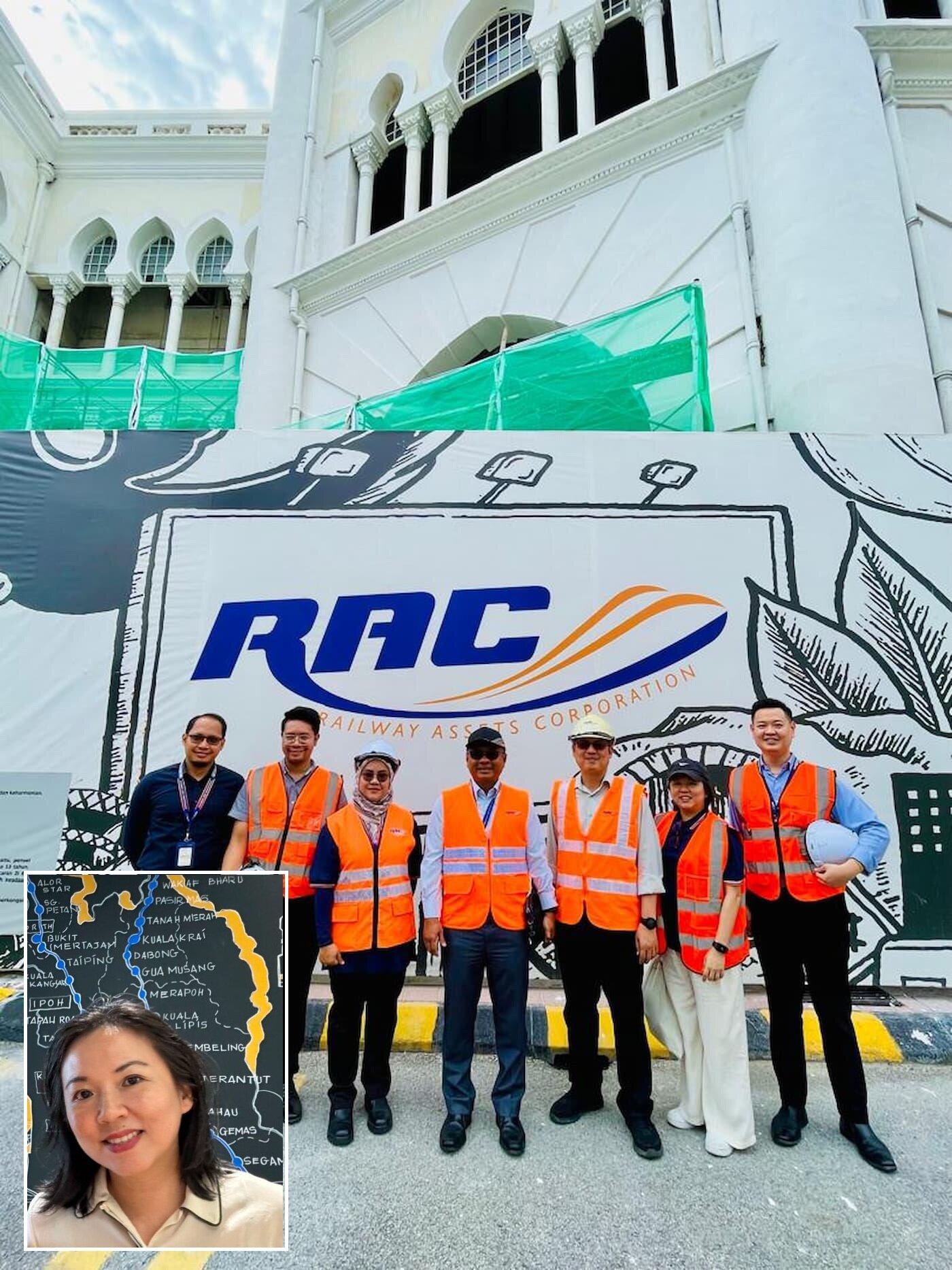
For Railway Assets Corporation Chief Operating Officer (Property) Lena Ng Hwei Ling, shaping Malaysia’s rail and urban landscape is both a professional calling and a personal journey through the city she has long experienced on foot.
Armed with a Bachelor of Architecture from Curtin University, Ng began her career in 1999 at T.R. Hamzah & Yeang under renowned architect Ken Yeang, whose ecological design philosophy introduced her early to sustainable urban strategies. Over the years, she worked on projects ranging from masterplans to hotels, luxury residences and data centres before moving into the rail asset management sector.
Yet Ng says the most important influence on her work did not come from design theory alone. “More important than architectural training, for me, was being a public transport user,” she says. “Taking public transport and walking in the city is very different from sitting in a car getting from one point to another.”
In fact, Ng does not drive at all! Instead, she relies on trains, walking and the occasional ride-hailing service – experiences that inform how she thinks about urban connectivity and safety.
“If I feel safe enough to take the train, walk from the station to the mall and then connect to my apartment, then that I see as a successful development,” she explains. “If I have to cross a highway, go under a bridge and walk through a wasteland, then that’s already a design flaw.”
Her perspective is particularly significant in sectors that have historically been male-dominated. Reflecting on nearly 26 years in the field, Ng says she has been fortunate not to face direct discrimination, but acknowledges an underlying bias.
“As a woman working in the field, you sometimes have to stand your ground further, especially if you believe in something,” she says. “Then you really have to fight for it.”
Ng says it has been rewarding to be part of the ongoing refurbishment of the KL Railway Station, one of the city’s most iconic heritage assets. Beyond that, her role involves overseeing transit-oriented developments and regenerating railway heritage assets across Peninsular Malaysia – from Perlis and Kelantan to Johor – giving her a unique vantage point on how rail connects communities.
“You see passengers not just as tourists, but locals travelling for family reunions,” she says. “You realise on a national scale what transportation can do to bring people together.”
One example of this philosophy is the transformation of underutilised railway land in Kluang into Laman Rel Mahkota Kluang, a community space that has quickly become a lively meeting place.
“Creating these kinds of spaces may have very little in terms of financial gains,” Ng notes. “But the cultural and community capital you can give back to people is really important.”
Having grown up in Kuala Lumpur, Ng has also witnessed the city’s dramatic evolution.
“Thirty years ago you didn’t go to KL after 6pm,” she recalls. “Now it’s really transformed – it’s safe and vibrant.”
For young women hoping to shape Malaysia’s built environment, Ng’s advice is simple: combine technical training with empathy and curiosity. “Success in this industry doesn’t come from sitting in an office and going back at five o’clock,” she says. “It comes from walking around, understanding the sites and understanding what people need.”