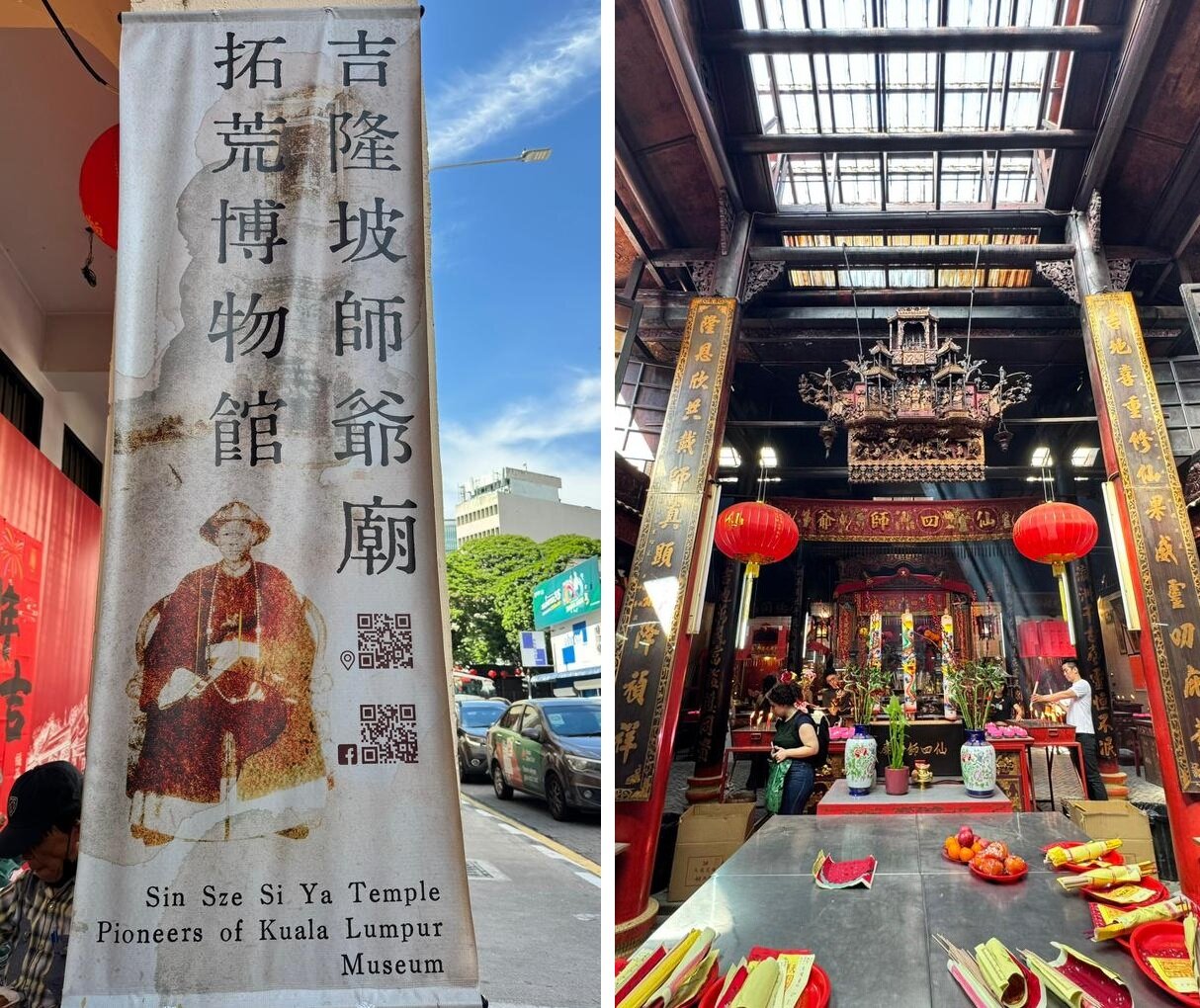
Sin Sze Si Ya is the oldest Chinese temple in Kuala Lumpur, built following one of the city’s most turbulent periods. The temple was established in 1864 by Yap Ah Loy, the third Chinese Kapitan of KL, during the Klang Civil War. This was a time of chaos, marked by warring sultans and Chinese gangs vying for control of the land.
The temple is devoted to two deities; Sin Sze Ya and Si Sze Ya, spirits believed to have guided Yap Ah Loy to victory during the conflict. Sin Sze Ya, in particular, is thought to be the spirit of Seng Meng Lee, a former Chinese Kapitan who was brutally killed in an ambush. It is said that when Kapitan Lee was beheaded, white blood flowed from his neck, marking him as a saint-like figure.
For their significance in this period, the two deities are not only revered at Sin Sze Si Ya but also worshipped in several temples across the country, in towns such as Seremban, Kajang and Rawang. This both anchors the temple in the city’s history and makes its deities distinctly Malaysian.
“Many temple deities can trace their origins back to China thousands of years ago, but Sin Sze Ya was only deified around 170 years ago, here on this land. They almost serve as guardian deities for all (Malaysian Chinese) temples,” says Ken Lim, Chief Executive of Sin Sze Si Ya.
“These deities do not exist in any other part of the world, not in mainland China, not elsewhere in South-East Asia, not even in Singapore, Sabah or Sarawak. It exists only on the Malay peninsula. This makes it unique not only to Malaysian Chinese communities, but to Malaysians as a whole.”
.jpg)
.jpg)
.jpg)
.jpg)
.jpg)
.jpg)
.jpg)