Still Schooling the City

SITI HAWA | 3 February 2026
WHO hasn’t heard of Victoria Institution? Fondly referred to as VI, it’s the oldest secondary school in Kuala Lumpur – celebrating its 133rd anniversary this year – and considered one of the more premier schools in the city.

From Form 1 to Form 5, VI only accepts male students, whereas female students are accepted for Form 6 (Lower and Upper).

Over the years, it has produced a long list of well-known figures from its alumni, who are known as “Victorians”, such as the Sidek brothers of badminton, business tycoon Ananda Krishnan, filmmaker and publisher Amir Muhammad, and politician Rafidah Aziz.

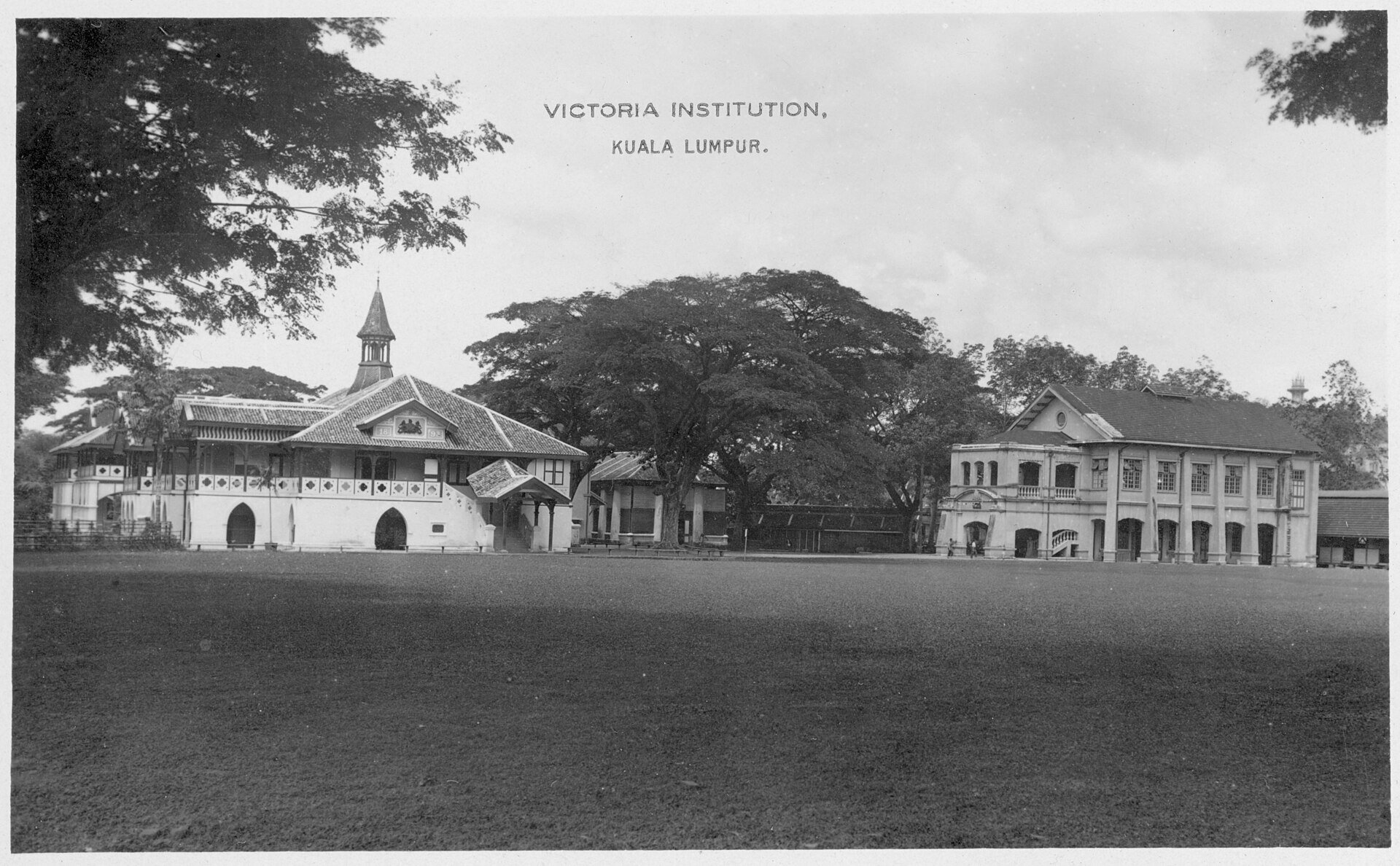
Founded on Aug 14, 1893, the school was established in commemoration of Queen Victoria's Golden Jubilee. Lady Treacher, wife of the then British Resident of Perak, Sir William Hood Treacher, laid the school’s foundation stone on High Street (now Jalan Tun H.S. Lee), where the school was first built. VI was officially opened on July 30, 1894.

Due to frequent flooding issues thanks to its proximity to the Klang River at its original site, the school moved to Jalan Hang Tuah (then Jalan Shaw) in 1929, where it has stood since. Today, you can find the foundation plate on the front facade of the current VI building.


An old postcard showing VI back in the day. – Photo: Wikimedia Commons
A distinguished design

Over a series of emails, historian Chung Chee Min, 84, shared his knowledge of VI with us. Chung’s ties with VI go way back – from 1953 to 1959, he was a student, before later on returning as a mathematics teacher, serving from 1965 to 1967.

Chung is the perfect person to talk to about VI: he’s written three books about it, chronicling its history and his memories of it (A Concise History of the Victoria Institution 1893-2002, The V.I. Anthology – Voices from the Golden Age and The Big School). He also contributes to and helps maintain the Victoria Institution Web Page.

According to Chung, British architect A.C. Norman designed the original VI on High Street. He also designed the St. Mary’s Cathedral next to the Padang (Merdeka Square).

“Some of the key details in the building’s design that Norman incorporated include a distinctly English Victorian cottage architectural style, featuring a mix of half-brick and half-timber with Gothic elements, such as arches on the lower floor,” says Chung.

As for the current VI building at Jalan Hang Tuah, it was designed by renowned Singapore-based architectural firm Swan & Maclaren in Art Deco style, featuring a main block in the shape of the letter “E” and a prominent clock tower. Interestingly enough, its contractor was Low Yat, who later founded the Low Yat Group.

VI’s iconic tower was elaborately designed in a “stripped” neo-classical style with baroque mannerisms. Key design elements include the dome-like cupola topped with a pinnacle, pilasters and vents, as well as cornices and triangular pediments. In 2009, the school was officially accorded National Heritage status.
Community hub

Despite its “elite” status, VI often opened its doors to the community throughout the years.

Located on Petaling Hill with a swimming pool, a large hall and a playing field large enough to allow three football or hockey matches to be played simultaneously, VI was one of the first schools to have such facilities, which weren’t exclusive to the school and its students.

For example, the school hall hosted the Malayan Badminton Championships in 1948. During the 1998 Commonwealth Games, some of the international cricket matches were played on the VI field. When visiting Malaya in 1955, US Olympian Jesse Owens gave our local sportsmen some one-on-one training at VI, and in 1957, US Olympic shot putter Parry O'Brien gave a public demonstration of his skills on the field.

VI’s central location and teaching facilities also allowed adult Higher School Certificate evening classes to be conducted at the school in the 1960s.

“This gave many members of the public a chance to gain admission to university. Prior to the establishment of teacher training colleges, “normal classes” were also conducted on its premises on weekends to produce trained teachers,” Chung shares.

In 1992, Malaysia won the Thomas Cup after a 25-year wait. Helping to wrest the Cup from Indonesia were six Victorians, four of whom are seen here in their moment of glory; (from left): Razif Sidek, Soo Beng Kiang, Foo Kok Keong and Rashid Sidek. Not shown are Jalani Sidek and Wong Ewe Mun (reserve).

A place of many firsts

VI has also become known as a place of many firsts for the country.

The Malayan scouting movement and the Cadet Corps movement was first started at VI, and the school’s 70-year-old Cadet Corps Band, established in 1909, is known internationally.

It was also the first school to stage public drama productions and to conduct its sports Olympic-style, with marchpasts and formal openings.

Its scholars often commanded headlines for their brilliant exam results, while its annual science exhibitions brought schoolchildren from across the city and the public to its science labs to learn more about science.

Yearly, VI sportsmen are known for winning the lion's share of championship trophies in all manner of sports.

“There was so much talent that the school at one time had five publications serving different interests published simultaneously by the boys. Its numerous alumni could and can still be found in all niches of Malaysia society, from the government, the professions and academia to the arts and business,” notes Chung.

A group photo of the school on its centennial in 1993.

Proud to be a Victorian

Recognised for its excellence in sports and academics, being a Victorian brings forth a deep sense of pride among its alumni.

Its symbolically unique crest – with its seladang (gaur) head and blue and white colours based on those of Cambridge University and Oxford University – is a source of great inspiration and pride to its pupils.

So, too, its three-verse school song with stirring lyrics (set to the tune of the medieval student song “Gaudeamus Igitur”) is inevitably sung proudly at weekly school assemblies and at the close of every VI alumni reunion around the world.

However, Chung lets us in on a little secret: in truth, VI has never had a motto.

“When the school newspaper was started in 1953, it adopted the motto ‘Be Yet Wiser’ on its heading, based on the biblical proverb, ‘Give instruction to a wise man, and he will be yet wiser.’

“However, over the years, later generations of its own pupils mistakenly thought that it was the school motto and so it eventually became the motto, officially! It's a good example of how mistakes can become facts,” says Chung.

The then Prime Minister Tunku Abdul Rahman was Guest of Honour at VI's 75th Anniversary celebrations in 1968.

Living heritage

For Chung, his time as a pupil and later as a teacher at VI exposed him to its rich history.

“The best students of Kuala Lumpur studied there, and the best teachers taught there. It also had many long-serving and caring headmasters, several of whom served more than the usual three years or so; indeed, its first headmaster Bennett Eyre Shaw served over 25 years and left his mark indelibly on the school,” says Chung.

When the internet came along, Chung saw it as the perfect opportunity to source more information and materials on VI from around the world and to tell the VI story to a wider audience.

“More than two decades later, the vast, multi-faceted VI story has still not been completely told!” he exclaims.

Thanks to its long, storied history, Chung believes that VI is a living heritage that should be preserved for future generations, a rare slice of time from a long lost age.

“There are already enough modern, gleaming glass buildings in Kuala Lumpur. But how many Art Deco buildings are there in Kuala Lumpur, let alone Malaysia?” he questions.

Chung shares that VI has been a very important part of our nation’s history, though many have forgotten. It was used by the Japanese as their headquarters during their occupation of Kuala Lumpur in World War II. More importantly, the Japanese surrender in 1945 was signed in the VI school hall – “This alone should be reason enough to preserve the school!” says Chung.

He tells us that he hopes more Malaysians will slow down as they drive along Jalan Hang Tuah and take note of the historic, living symbol that, since 1893, has been an integral part of Malaysia’s fabric. “It would be great if they conducted guided tours at the school, so tourists and locals alike can appreciate what is sitting right at their doorstep.”

Following tradition dating from the 1920s, VI prefects are dressed in blue shirts and white coats and pants.

Discover more stories

Ooops!
Generic Popup2