From Garden Bed to Shared Table

MANJEET DHILLON | 17 February 2026

The Satu Rasa menu included an ulam lou sang which was a joyful combination of pomelo, sengkuang, limau purut, bunga kantan, pegaga and ulam raja – herbs that have long appeared on Malaysian tables, often gathered fresh and eaten communally. – Photos: Manjeet Dillon

TUCKED behind the historic Young Women’s Christian Association (YWCA) building on Jalan Hang Jebat, a narrow path slips quietly away from the street. In a district better known for its heritage shophouses and long-standing trades, the path opens into an unexpected pocket of green.

Here, “Sayur in the City” has been cultivating herbs and vegetables for about eight years. Near the entrance stands a Brazilian longan tree that predates the project by at least two decades – a quiet reminder that this plot has been tended in different ways over time. The garden does not replace the area’s history; it adds another living layer to it.

It was in this setting that Eats, Shoots & Roots hosted its annual Farm-to-Table Brunch. Now in its seventh year, the 2026 edition was themed Satu Rasa, meaning “one taste”. The concept centred on presenting dishes from different cultural traditions at a shared table, using produce sourced partially from the garden itself – linking soil, kitchen and community within the same urban space.

Before guests took their seats indoors, they were led through the garden beds to see where some of the herbs and vegetables had been harvested earlier in the week. A brief morning shower had just cleared. The soil remained damp, leaves carrying a thin sheen of water – a small but steady reminder that even in the heart of the city, cultivation continues.

Raised planters keep the space organised. Ulam grow in clusters: pegaga (Asiatic Pennywort), ulam raja (Wild Cosmos), limau purut (Kaffir lime leaves) alongside chillies, including cabai burung ungu (Purple Bird's Eye Pepper). Some beds appear empty at certain times. This is explained as part of the natural life cycle of the plants.

At the composting area, food waste from the kitchen is returned to the garden using underground bio pores. These are designed to keep rodents out while allowing organic matter to break down safely. Rice husk is used as a carbon cover for the food waste. Unlike soil or ready-made compost, rice husk holds its structure longer and helps regulate moisture as decomposition takes place. The compost produced feeds back into the planting beds, creating a closed loop between kitchen and garden.

A composting structure built from stacked bricks, where organic matter is returned to the soil as part of the garden’s nutrient cycle.

In many ways, the system recalls older Malaysian food traditions, when kitchen scraps were rarely discarded and backyard plots sustained daily meals. Long before “urban farming” became a term, households across kampung communities practised small-scale cultivation, growing ulam, herbs and vegetables just steps from their kitchens. Here in the city centre, those principles are adapted for contemporary urban life. The garden becomes not just a sustainability project, but a continuation of lived knowledge – proof that heritage can reside in habits as much as in architecture.

Following the garden tour, guests moved indoors for the main event: the Farm-to-Table Brunch. The programme opened with a presentation from Beatrice Yong, Strategy Director at Eats, Shoots & Roots, who shared the organisation’s milestones and outlined how its garden projects, workshops and training initiatives have developed over the years.

Eats, Shoots & Roots began developing the garden in 2017 with initial support from Think City. Since then, seven core volunteers have helped maintain the site while public programmes expanded to include Friday garden sessions. Saturday tours and specialist workshops such as Horticulture 101 and vermicomposting, with corporate groups now joining regularly; there are also more children’s programmes in development.

During her presentation before lunch, Yong outlined how the brunch sits within a broader calendar of public programmes. Monthly garden tours continue throughout the year, alongside hands-on sessions such as the Ulam Taste Tour, which introduces participants to seasonal herbs followed by a curated tasting drawn from the garden. A Mini Garden Experience offers a guided sensory walk through edible plants, ending with a simple planting activity that participants can take home.

More in-depth sessions are also available. The Home Edible Garden Workshop series covers soil basics, container growing, no-dig beds and plant propagation, designed for urban residents looking to start small-scale gardens in their own homes. According to Yong, these sessions aim to make food cultivation less intimidating and more accessible within dense city environments.

“We design our workshops so that people can participate regardless of experience,” Yong said. “When they see how waste becomes soil and soil becomes food, sustainable urban living becomes practical rather than theoretical.”

Buffet service featuring dishes prepared under the guidance of Chef Kamala, using produce sourced partially from Sayur in the City’s urban farm.

Lunch was prepared under the guidance of Chef Kamala, who has more than 40 years of culinary experience. For the students of the YWCA Vocational Training and Opportunity Centre (VTOC), the event formed part of their weekly training routine. Each week, they spend two hours working in the garden: weeding, maintaining beds and harvesting produce, before entering the kitchen to prepare dishes using what has been grown.
 
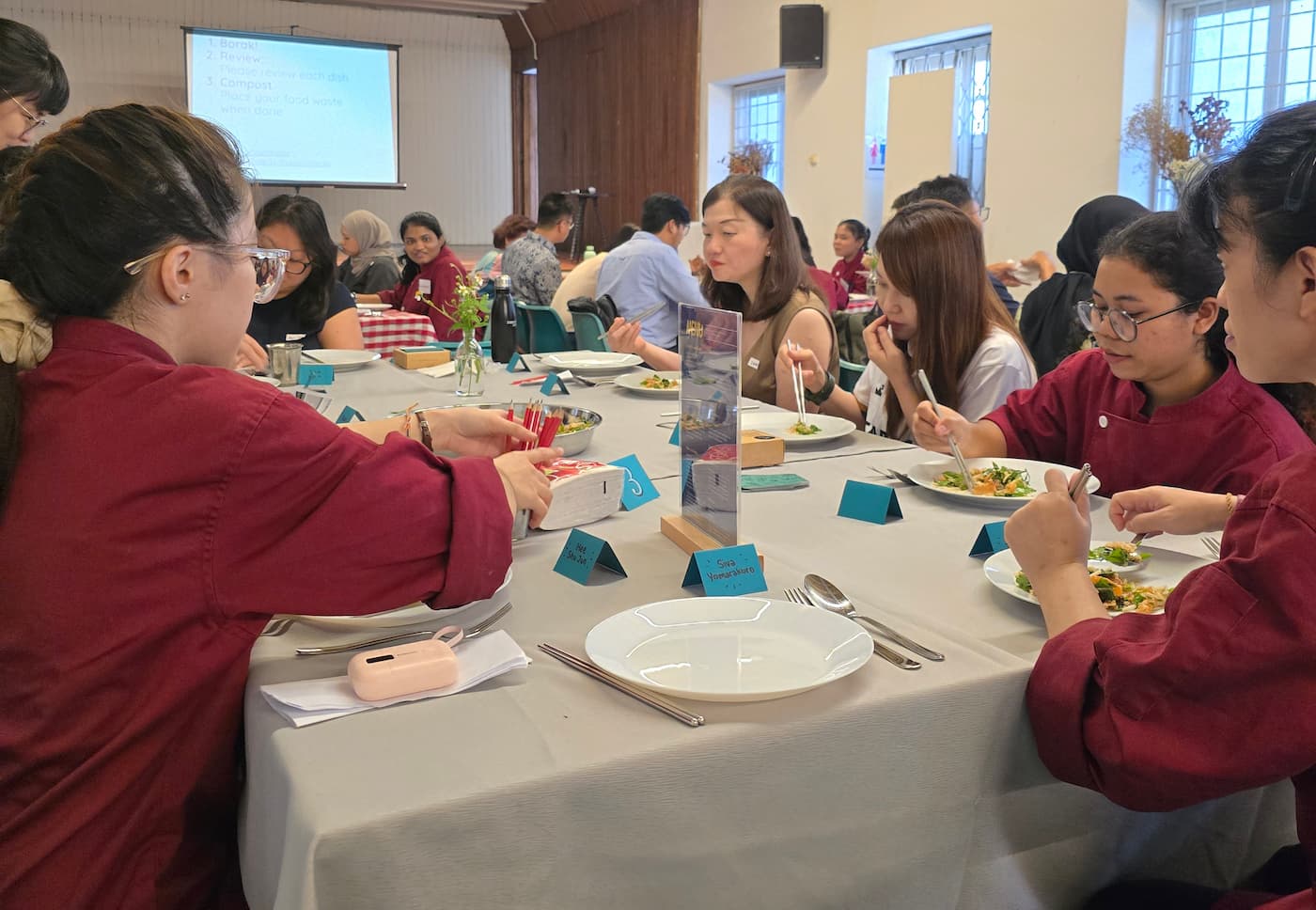
Students played an active role in presenting the dishes. Groups of three introduced each dish in English, Mandarin and Tamil before returning to their tables to dine alongside guests. Conversation cards were placed on each table to prompt discussion.  
  
The multilingual introductions reflected the spirit of Satu Rasa beyond the menu itself. In a city shaped by layered communities and shared histories, language becomes part of the meal. The act of standing together to describe a dish – grown nearby, prepared collectively – echoed the rhythms of Malaysian celebrations where food, speech and storytelling are intertwined.
  
The menu moved across different culinary traditions without attempting to blend them into a single style. Kung Pao Jackfruit reworked a Sichuan classic using young jackfruit in place of chicken. Sayur lodeh brought coconut milk and vegetables into a Malay-style broth. Okra raita, cool and lightly salted, sat beside Satu Rasa Rice, which included spinach, carrots and sweet potato.
  
An ulam lou sang combined pomelo, sengkuang, limau purut, bunga kantan, pegaga and ulam raja – herbs that have long appeared on Malaysian tables, often gathered fresh and eaten communally. The tossing gesture prompted laughter and raised chopsticks across the table, transforming a festive ritual into a shared urban moment.
  
Rather than a formal service, the meal unfolded as a communal lunch. Students and guests ate together, reflecting a longstanding Malaysian custom: that food tastes different when shared. In this setting, cultivation, preparation and conversation formed one continuous cycle.
A guided walk through the raised beds, with participants observing plant growth and soil conditions at close range.

“The garden is where the learning starts,” Yong said during her presentation before lunch. “But it only becomes meaningful when students carry it through, from planting to preparation to sharing the meal.”  

At the end of her address, she added, “Let’s keep giving together.”   
  
In a neighbourhood defined by historic buildings and long-standing trades, Satu Rasa offers a quieter form of continuity. It suggests that heritage is not only preserved in brick facades and old documents, but also in everyday practices – in how food is grown, how knowledge is passed on, and how people gather around a table.

Behind the familiar frontage of the YWCA on Jalan Hang Jebat, seeds are planted and stories are shared. As long as soil is tended and meals are eaten together, Kuala Lumpur’s heritage continues to grow – not only in memory, but in living, edible form.

Discover more stories

Ooops!
Generic Popup2