Recipes That Settled

MANJEET DHILLON | 19 April 2026

Illustration: AI interpretation of a Kuala Lumpur street food scene

IN Kuala Lumpur’s historic core, heritage is often read through buildings: shophouses, temples, civic landmarks. They mark the city’s past in visible ways. But much of that history continues elsewhere: in kitchens, at stalls, in things that are made and eaten without much notice. Meals are taken quickly, sometimes while standing, or packed to go. The histories behind them are rarely considered at the moment.

Across KL, certain foods carry those traces as part of the city’s living heritage. Ingredients are replaced, techniques adjusted, uses expanded. The point is not only where these dishes began, but what happened after: how they were made again, and differently, once they arrived.

Steamed Traditions: Putu Bambu

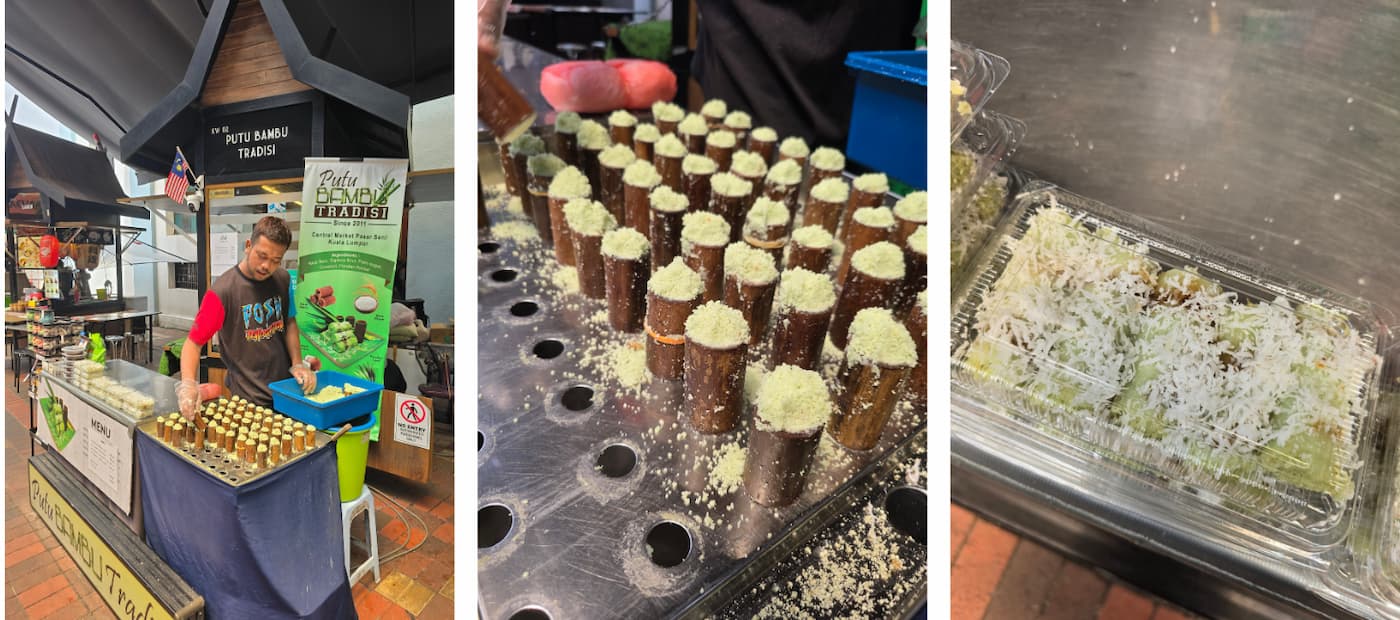
Putu Bambu is a street-side snack made from rice flour, palm sugar and grated coconut. It is steamed inside short bamboo tubes, which give it a cylindrical shape. The word “putu” is linked to South Indian languages, used broadly for steamed preparations based on rice and coconut.

Similar preparations appear across South and South-East Asia. In South India, idiyappam (putu mayam) is pressed into fine strands before cooking, often eaten with grated coconut and palm sugar. The same pairing appears here, though the form differs, the flour is packed into bamboo tubes and steamed into a compact cake.

In Kuala Lumpur, Putu Bambu is prepared in small batches at roadside stalls. The tubes sit upright over steam, lifted off one by one. Putu Bambu is eaten warm, often while one is standing nearby, before moving on.

Colonial Adaptation: Bergedil

Bergedil (also spelled perkedel), traces back to the Dutch frikadel, a minced meat patty. Versions of this exist across Europe, but it was carried through Dutch colonial routes into the Malay Archipelago.

In the Dutch East Indies, where meat was not always accessible, potatoes, introduced through colonial trade and once known locally as kentang Belanda, took its place. From there, it moved across the region, carried between Indonesia and Malaya.

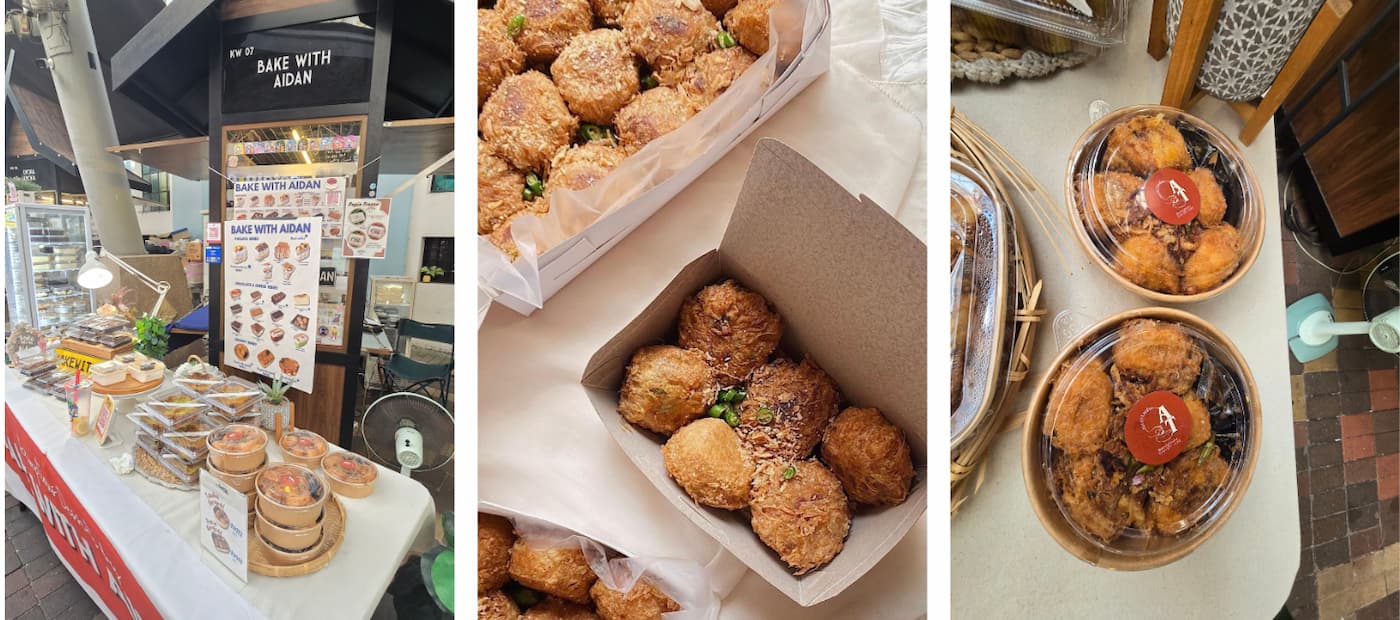
What you find today is built around mashed potato. It is seasoned, shaped and fried. Fried shallots, white pepper and herbs are common; sometimes a little minced meat is added, often not. It appears at home, at nasi campur stalls, in everyday settings, no longer marked by where it began.

From Plantation to City: Teh Tarik and Roti Canai

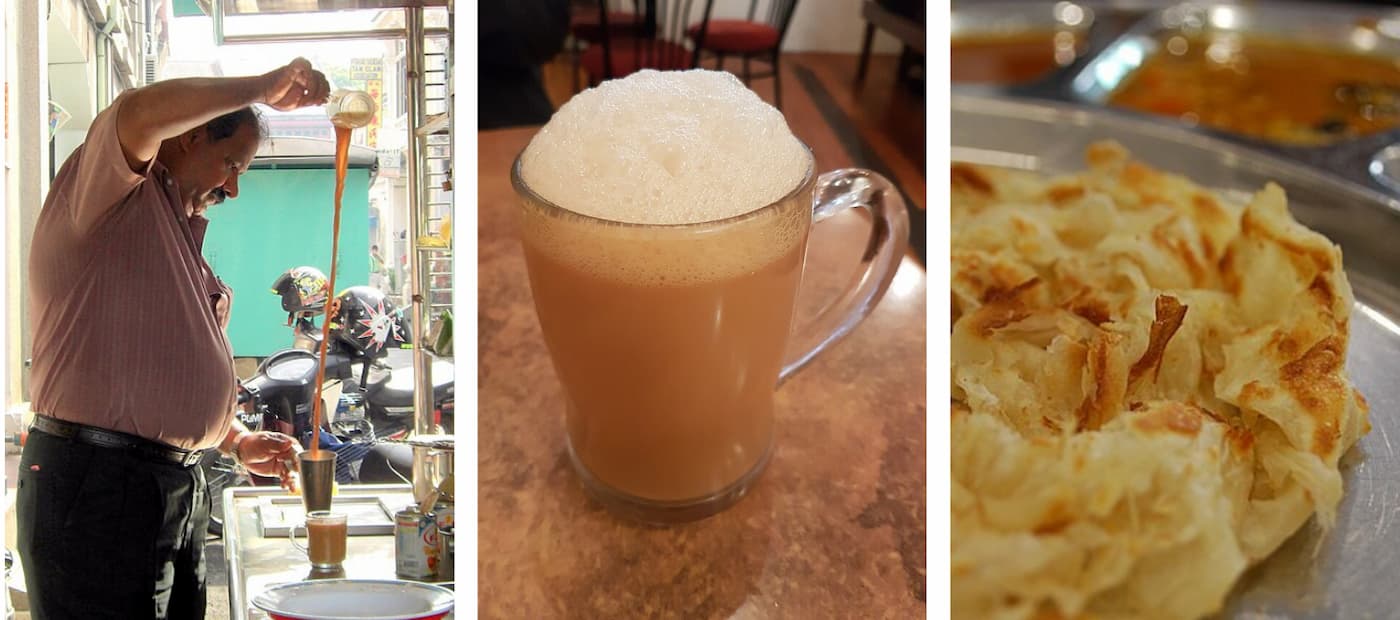
Tea in Kuala Lumpur is most recognisable as teh tarik, brewed tea mixed with condensed milk and poured between cups in a repeated pour-and-pull motion to cool and aerate it. The movement is distinctive, but the drink itself comes from earlier practices.

Its roots lie with Indian Muslim migrants who set up sarabat stalls near rubber plantations after the Second World War, serving workers at the edge of the estates.

Over time, they moved. From plantations to towns, and eventually into the city. Today, teh tarik is most closely associated with mamak restaurants, linked to Indian Muslim communities whose presence in the region includes earlier trading groups from the Coromandel Coast, sometimes referred to as Chulias.

Tea is almost always taken with something. Roti canai is prepared alongside it, where the dough is worked quickly by hand, flattened, folded and flipped in a continuous motion and cooked on a flat griddle. It is linked to South Indian parotta, brought by Indian migrants to the Malayan peninsula.

The name carries its own uncertainty. Some connect “canai” to Chennai; others to the Malay term for kneading dough. Either way, the dish is no longer tied to that origin. It is eaten across communities, at all times of day, part of KL’s routine.

Street Adaptations: Apam Balik

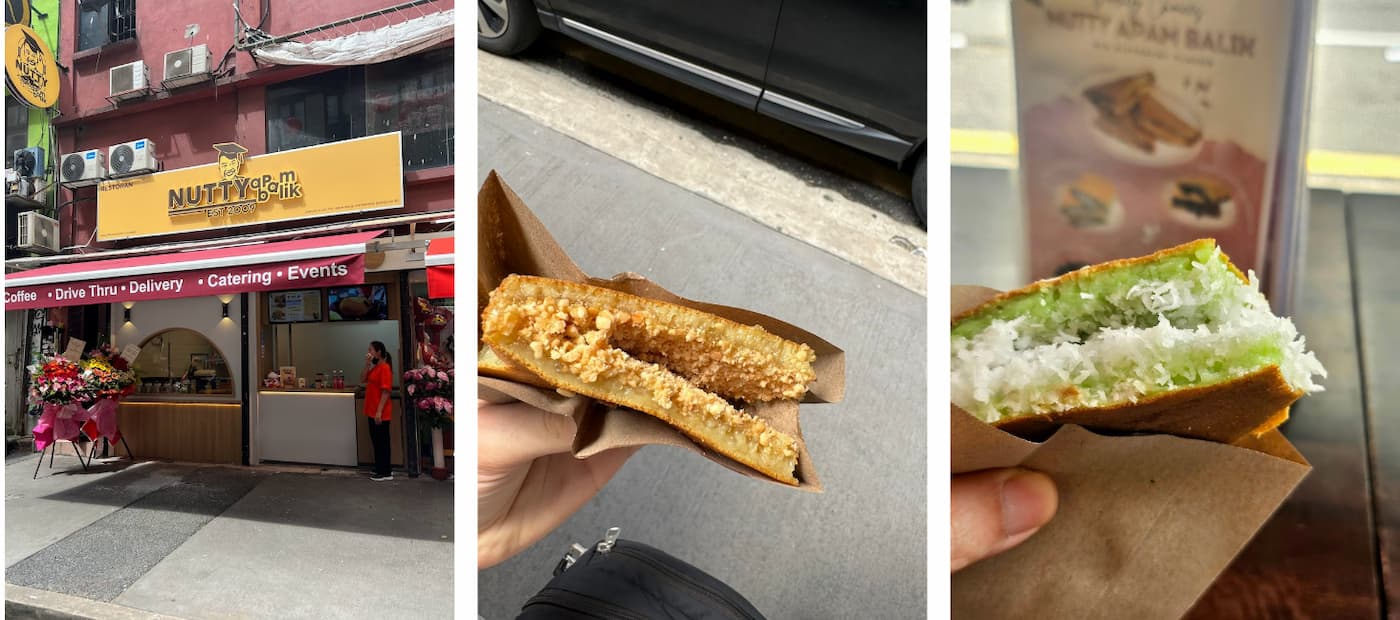
Apam Balik appears in many parts of South-East Asia under different names. In Kuala Lumpur, it is a folded pancake cooked on a flat griddle, filled with crushed peanuts, sugar and sometimes corn. In Hokkien, it is known as ban chiang kueh, brought by southern Chinese migrants from Fujian.

Here, the versions vary. Some are thick and soft; others are thin and crisp. Batter is poured, left to set, then filled and folded while still hot. The edges crisp as it cooks, while the centre remains soft. The filling is pressed in just before it is folded over. The process is repeated throughout the day, with new pieces coming off the griddle as orders come in.

Along Jalan Hang Lekir, a pandan version is filled with fresh grated coconut. The batter takes on a light green tint, slightly fragrant, setting it apart from the more common peanut-filled version. Other stalls use sweet corn. The differences are small but noticeable: a flat griddle, a short wait, something handed over warm.

Teh tarik is ordered alongside roti canai, the two arriving in quick succession at the table. Bergedil sits among other items on a mixed plate, selected without much pause. Apam Balik is folded into paper and eaten while walking. Putu Bambu is lifted from the tray and eaten warm, often standing nearby.

These patterns are repeated across the city each day, shaped by time, place and habit. What continues is carried through daily practice. Recipes record not only where people came from, but how they settled, and how those movements remain present in the city.

Where to find these dishes in Downtown KL
Putu Bambu - Kasturi Walk: a dedicated Putu Bambu stall
Bergedil - Kasturi Walk: Bake with Aidan
Apam Balik - Nutty Apam Balik, Jalan Hang Lekir
For more articles on F&B in Kuala Lumpur, check out our Kisah Warisan Kita series!

Discover more stories

Ooops!
Generic Popup2