Art in Quiet Rooms

ELLFIAN RAHIM | 6 April 2026

Standing before the charcoal and acrylics works, 'Kepong: The Widow' and 'Potemkin: The Cry', time seems to hold its breath – Kelantan-born visual artist Poodien’s work at +n by UR-MU invites a moment of quiet reckoning, where gaze meets story and lingers just a little longer.

KUALA Lumpur rarely asks you to slow down – but its galleries do.

Tucked between busy streets and familiar landmarks are spaces that invite a different pace altogether. Here, the city softens. Footsteps echo a little louder, conversations lower to a murmur, and attention sharpens. In these quieter rooms, art is not something you pass by – it is something you sit with.    
    
Viewing and experiencing art in galleries and studios invites stillness and close looking. Yet these are far from passive spaces. Paintings, sculptures, mixed media and installations carry distinct voices, each shaped by intention and context. Lighting is deliberate, silence is part of the design, and even the act of moving through a room becomes part of the encounter.    

What begins as a visual experience often deepens into something more layered – emotional, intellectual, sometimes even spiritual. It is not just about seeing, but about engaging.    

Along Jalan Tun H.S. Lee, UR-MU offers one such setting. Housed in a refurbished 1940s shophouse in Chinatown, the space holds both memory and modernity within its walls. For Isabel Yap Quan-E, gallerist at +N by UR-MU, this coexistence is part of what makes Kuala Lumpur so compelling.

“One could say that for some, being here in this area is like standing in history, in spite of the modern changes, most buildings retain their old look. Being in this room where many, many bits of history have unfolded before in the past can bring a lot more inspiration and imagination for art,” she says.


“But most of all, galleries are important for the fact that art is not meant to be archived away. Instead, it’s meant to be seen, understood and discussed. As a space, galleries facilitate these activities through curating exhibitions, talks, events, which in turn, contribute to local arts and culture activity.”

The +n gallery, for instance, extends beyond exhibitions into intimate, participatory experiences – from life drawing and craft workshops to live music and poetry nights – where art shifts from something on the walls to something shared in the room.    
    
These small-scale sessions invite visitors to engage more closely, turning the gallery into a space for making, listening and quiet exchange. In fact, these days, this seems to echo across the city’s gallery landscape, where spaces act less as containers and more as facilitators – holding space for dialogue between artist and viewer.    

For the art lover visiting Kuala Lumpur, these encounters extend well beyond a single stop. In Brickfields, Wei-Ling Gallery presents thoughtfully curated exhibitions that have long shaped contemporary Malaysian art discourse. The gallery’s programme often bridges generations of artists, offering both critical depth and an accessible entry point for those new to the scene.

Now Showing: ‘Unbounded’ by Chen Wei Meng at Wei-Ling Gallery, Kuala Lumpur, on view through April 30, 2026.
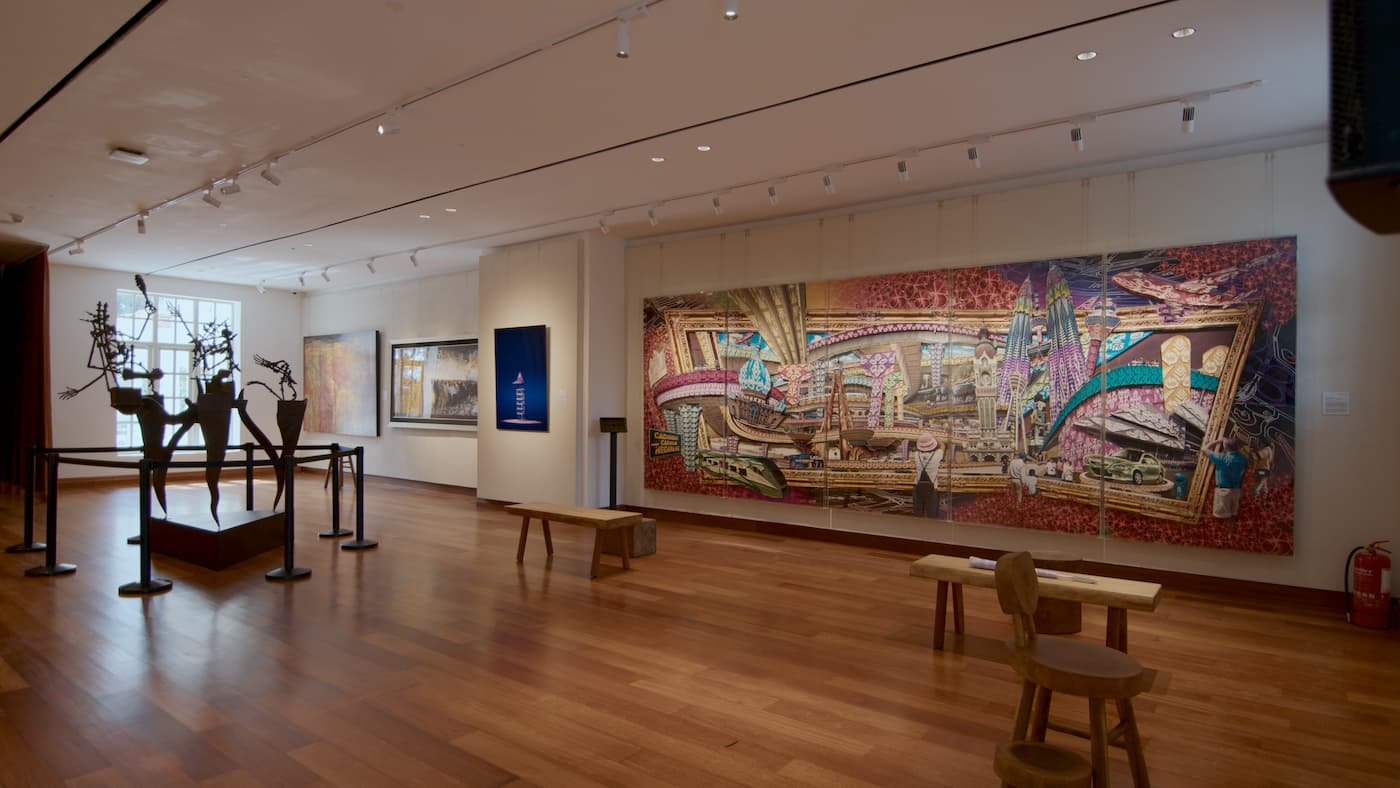
Closer to the city’s historic core, Seri Negara houses a smaller, more intimate gallery space. Here, artworks from Galeri Khazanah’s Shifting Landscapes: Mapping Space, Time and Memory collection currently sit quietly within a building steeped in history, creating a dialogue between the pieces on display and the architecture that surrounds them.

Institutional spaces offer yet another perspective. At Balai Seni Maybank, managed by the Maybank Foundation, exhibitions often foreground regional narratives and emerging voices. Meanwhile, the Bank Negara Malaysia Museum and Art Gallery brings together art, economics, and national history in a setting that is both expansive and contemplative.    
    
And just beyond the immediate Warisan KL neighbourhoods, larger institutions continue to anchor the city’s visual arts ecosystem. The National Art Gallery offers a sweeping overview of Malaysian art, while Ilham Gallery is known for its sharply curated exhibitions that situate local practices within regional and global conversations.

Tucked within Seri Negara, a series of themed galleries traces the nation’s political, social and cultural journey – beginning at Ruang Merdeka, where works from Galeri Khazanah's art collection set a reflective tone.

Back on Jalan Robertson, where Merdeka 118 rises above the skyline, GMBB expands the idea of what a gallery space can be. Positioned as a “creative community mall”, it brings together studios, project spaces and independent makers under one roof–blurring the lines between creation, exhibition and commerce.

“Within our walls, we provide a space for the creative community to practice their trade and craft, and learn how to scale up as artistic enterprises and businesses,” says Lim Ying Xian, GMBB’s Senior Manager of Programmes and Partnerships. 
   
“Since we try our best to balance our corporate interests with our creative cause, the community that we have built around us is a major component in how we work. Simply put, creativity is our purpose, and a mall is how we function as a commercial entity.”      

“Today, with over 100 tenants across nine floors (10 including the ground floor), GMBB has become a space that allows creative and cultural practitioners with diverse skillsets the opportunity to find their footing and carve out their niche.”

Importantly, the space remains open in both spirit and structure.

At GMBB, Danielle Lin works within her space at Daniellelinart – where studio and storefront blur, and her works unfold naturally on the walls.

“This practice is one of the key outcomes of our vision and open-door policy since 2018. Arts appreciation is all about understanding the value of art – it is as much about the process as it is about the product.” Lim adds: “For that to happen sustainably, it needs to be cultivated in a natural and organic way.”

Taken together, these spaces reshape how galleries are understood. They are not exclusive enclaves, but quiet custodians of visual culture – places where stories are constructed, challenged and shared.   
    
For those willing to step inside, Kuala Lumpur reveals another rhythm. One that is less about movement, and more about attention.

Discover more stories

Ooops!
Generic Popup2